In a season marked by injuries and inconsistency, Rui Hachimura emerged as one of the few bright spots for the Los Angeles Lakers during their playoff run. Yet, despite his heroic efforts, the team fell short after being swept by the Oklahoma City Thunder in the second round.
There’s a running joke among Lakers fans about “four things not to criticize” regarding Japan, and Hachimura is one of them. This playoff season, he stepped up when the team needed him most. With Luka Dončić and Austin Reaves sidelined due to injuries, Hachimura averaged 16.7 points per game over nine playoffs—a career-high for his seven-year NBA tenure.
Some argue that at 28 years old, this is his final chance to secure a major contract. He left it all on the floor, but was it enough? Let’s break down his statistical value this season.
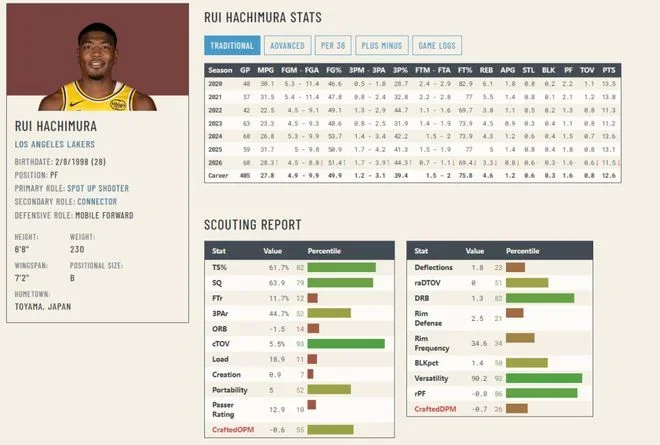
According to Crafted NBA’s composite ratings, Hachimura’s offensive prowess (Crafted OPM) ranks above 55% of the league—solidly above average. However, his defensive impact (Crafted DPM) sits at just the 26th percentile, far below average. He is a classic offensive-first, defensive-liability player. For him to be an effective positive contributor, his offensive production must overshadow his defensive shortcomings.
Basketball is a team sport, and the Lakers’ current roster construction exacerbates this issue. With LeBron James, Luka Dončić, and Austin Reaves all being offensive-minded players with defensive weaknesses, adding another one-way player like Hachimura only worsens the problem.
When the lineup featuring Deandre Ayton, Hachimura, and the “Big Three” played together (132 minutes total), the Lakers posted a net rating of -14.3 points, -2.7 rebounds, -6 assists, -4.7 steals, and +4.7 turnovers per 100 possessions. They also had just one block advantage. The chemistry was simply broken, like the old proverb: one monk carries water, two monks share the load, three monks have no water at all—and four monks are left completely dry.
Hachimura’s role in this imbalanced system took a hit in the regular season. His scoring average dropped from 13.1 points per game last season to 11.5, and his field goal attempts fell from 9.8 to 8.8. He even lost his starting spot midseason. But when we isolate his individual offensive efficiency, the numbers tell a more nuanced story.
From his 11.5 points per game: 6.5% came from free throws, 20.5% from mid-range, 28% from the restricted area, and 45% from three-point range—a high ratio of mid-range and three-point shots indicates his reliance on perimeter shooting. Of his total scoring, 87% came off assists, the highest among Lakers starters. Only 13% came off self-created shots. He functions like a howitzer: catch the ball, fire away without hesitation.
His accuracy made those shots count. He took 248 catch-and-shoot three-pointers—ranking 69th in the league and 2nd on the Lakers (behind Marcus Smart’s 256). He hit 109 of them at a 44% clip, second only to Luke Kennard’s 45.9% on the team. From mid-range, he attempted 170 shots, hitting 93 at a scorching 54.7%—a rate even surpassing Kevin Durant’s efficiency.
He was the most reliable catch-and-shoot weapon on the team, a trusty assist target for his teammates.
Come playoff time, with Dončić and Reaves out, his offensive role expanded. His shot attempts rose from 8.8 per game in the regular season to 11.9, and his scoring surged to 16.7 points per game, making him the Lakers’ second-leading scorer behind LeBron.
In those nine playoffs, 3% of his scoring came from free throws, 12% from mid-range, 27% from the restricted area, and a staggering 58% from three-point range. Assists on his made shots climbed to 93%. He stationed himself beyond the arc, waiting for opportunities, and his shooting was scorching hot. He hit 29 of 47 catch-and-shoot threes (61.7%) in the playoffs. Against the Rockets in the first round, he connected on 17 of 29 (58.6%) and was a key factor in the series win. Then, in the first three games against the Thunder (all losses), he hit 12 of 18 (66.7%) from deep.
His elite catch-and-shoot capability aside, his defensive shortcomings have prevented him from becoming a top-tier 3-and-D player. If he had average or slightly above-average defense, a $20 million-plus annual salary would be easy for teams to offer. How bad is his defense? The numbers are clear.
In the regular season, opponents shot 50% (4.7 of 9.4 attempts) when defended by Hachimura, 3 percentage points above their normal averages—a below-average defensive efficiency. Detailing by position:
– Defending guards: 340 minutes (45% of his total defensive time). Guards shot 44.5% against him, which is acceptable. His size and wingspan allow him to effectively pressure smaller players.
– Defending forwards: 325 minutes (43%). Forwards shot 52% against him—very poor. He primarily plays the four, meaning he offers little resistance against his direct counterparts.
– Defending centers: 92 minutes (12%). Centers shot a disastrous 71% against him. He is useless as a center defender and cannot help Ayton share the load in the paint.
In the first round against the Rockets, Hachimura’s defensive assignment was relatively easy. He guarded Amen Thompson, a player known for defense but with raw offensive skills. Thompson shot just 36% (8 of 22) when defended by Hachimura. Small forward Jabari Smith Jr., despite being a threat from mid-range, shot 38.6% (7 of 19) against him.
But against the Thunder, the story flipped. In the first three games, he guarded Chet Holmgren for 11 minutes, allowing 6 of 9 (66.7%). Defending Isaiah Hartenstein for 6 minutes and 30 seconds, Hartenstein shot 85.7% (6 of 7). Hachimura’s defense was essentially non-existent.
In Game 4, Hachimura played 43 minutes and scored 25 points—second on the team—making 8 of his 12 shots and 4 of 8 from three. Offensively, he was flawless. As the saying goes, “When the kingdom of Shu fell, it was not due to failures in battle.”
The 2025-26 season is over for the Lakers and Hachimura. The future is clouded with uncertainty. LeBron’s future is unknown, and Austin Reaves’ contract situation remains unresolved. Their decisions will directly impact Hachimura’s path forward. Hopefully, he can carry his playoff hot streak into the rest of his career and become the feared offensive weapon he has shown he can be.