

Krasnodar did not deserve their defeat to Dynamo in round 29, yet they lost 1-2 and dropped to second place. Why did this happen?
Why Krasnodar Couldn’t Finish the Job
After the first half, my notes read: “Krasnodar is in control. Dominant at set pieces, ready to explode on the counter at any moment, calm, and completely unfazed by Dynamo’s pressing and attempts to cover the midfield.” It seemed Dynamo had no chance.
I was preparing to write about Krasnodar’s set-piece prowess, one of Murad Musaev’s team’s main weapons this season, especially after Diego Costa scored from a classic routine—sprinting from behind the defense.
Krasnodar was more organized and sharper, even if the first half wasn’t particularly dazzling. Before the match, it seemed they would miss Giovanni González’s activity and crosses, but Valentin Pal’tsev also managed to support the attacks. Twice he dangerously sent the ball to the far post—first behind Danil Glebov for the onrushing Eduard Spertsyan, then to Nikita Krivtsov, where Juan Cáceres lost his man and headed it back to the midfielder for a shot.
In typical matches like this, Krasnodar calmly grinds out a win: maximizing pragmatism, dominating duels, pushing the opposition back with pressing and long balls to John Córdoba, and catching them on the counter. This time was different: early in the second half, Krasnodar missed Cáceres’ run and lost their advantage.
After that, they regrouped and almost snatched a win. In the 72nd minute, Kevin Lenini shot across goal from the rebound after a Pal’tsev throw-in. Immediately after, Spertsyan crossed low from a corner, Krivtsov let it run at the near post, and Córdoba shot over after a frantic clearance by Nicolás Marichal.
Then Dynamo gifted Lenini a dangerous chance. Their counter-pressing on the opposition half fell apart: Cáceres didn’t track Krivtsov, Glebov and Timofei Marinkin shifted to Spertsyan and Douglas Augusto, while Ivan Sergeev, Mumi Ngamale, Ulvi Babaev, and Anton Miranchuk stayed high. As a result, Lenini was left alone and launched an attack, with Córdoba producing an elegant lob into the box.
Krasnodar pressed methodically, had more shots (7-3) and touches in the box (15-3). Dynamo struggled and didn’t control the defensive zone. Miranchuk cleared straight to Lenini for a shot, Marichal and Cáceres blocked each other while clearing to set up Córdoba and Augusto. Then from a Dynamo corner, Cáceres created a chance for Juan Bosegli: he cleared the rebound onto Jubal’s foot and let the speedy Krasnodar player go through midfield.
Krasnodar could have easily scored three or more. But at the crucial moment, their finishing let them down.
Tyukavin and Luniev Kept Dynamo Alive and Lifted Zenit to First Place
Konstantin Tyukavin, Andrey Luniev, Bitello, Cáceres, and Ivan Sergeev were the key figures for both Dynamo and Zenit—they lifted the St. Petersburg side to the top.
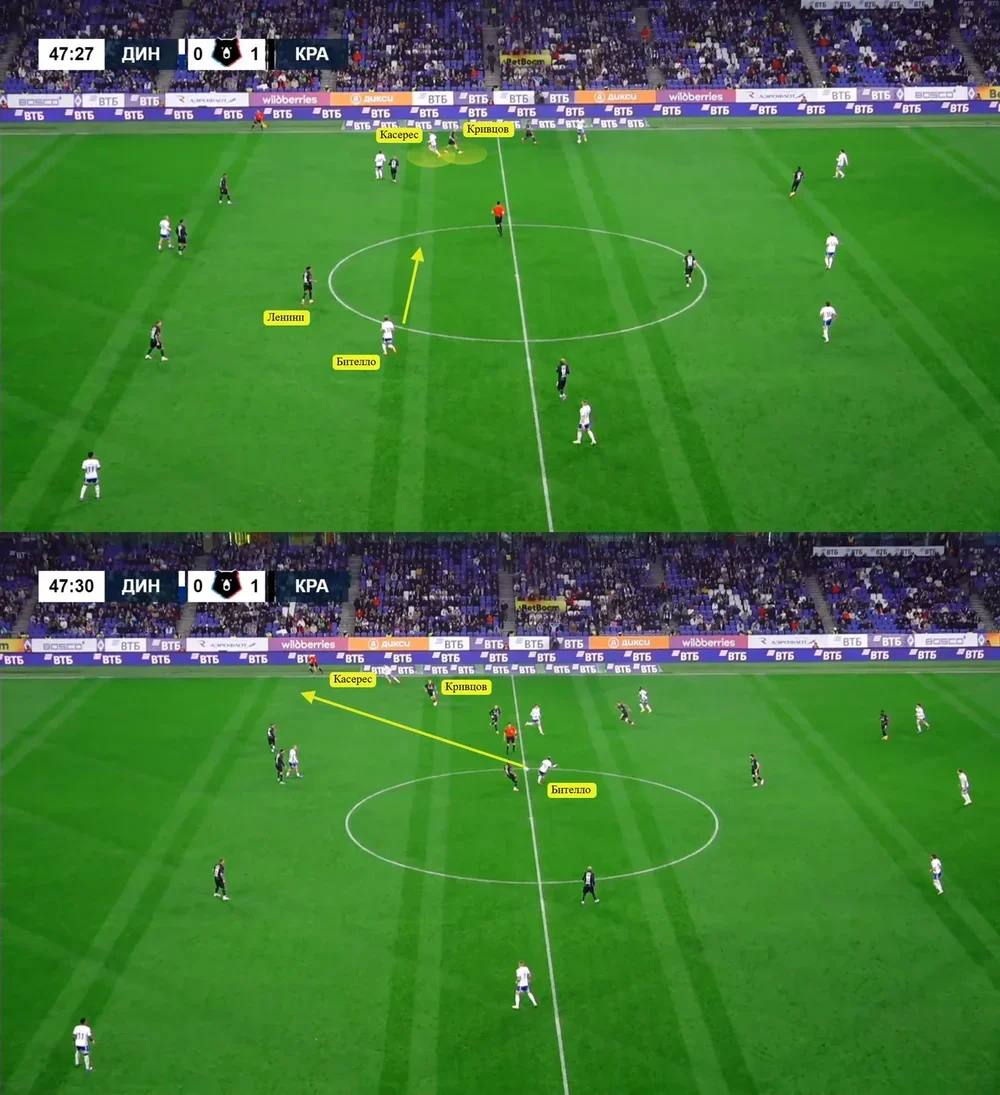
The first four turned the game around with the opening goal. It started with Luniev: Krasnodar creatively played a free kick in the middle third, Spertsyan rolled a promising pass to João Batxi—but it was intercepted by Luniev, who instantly launched the ball to Bitello. The Brazilian held it up on the left, switched the attack to the right, then drifted inside, lost Lenini, and played a first-time ball to Cáceres. Dynamo also found space well: Ngamale dropped deeper and took Lucas Olaza with him, while Krivtsov lost Cáceres’ run.
Then came Tyukavin’s textbook finish. He feinted to send Vitor Tormenta the wrong way and sprinted to the near post for Cáceres’ superb cross. That was Dynamo’s last shot and touch in the opponent’s box until the 85th minute.
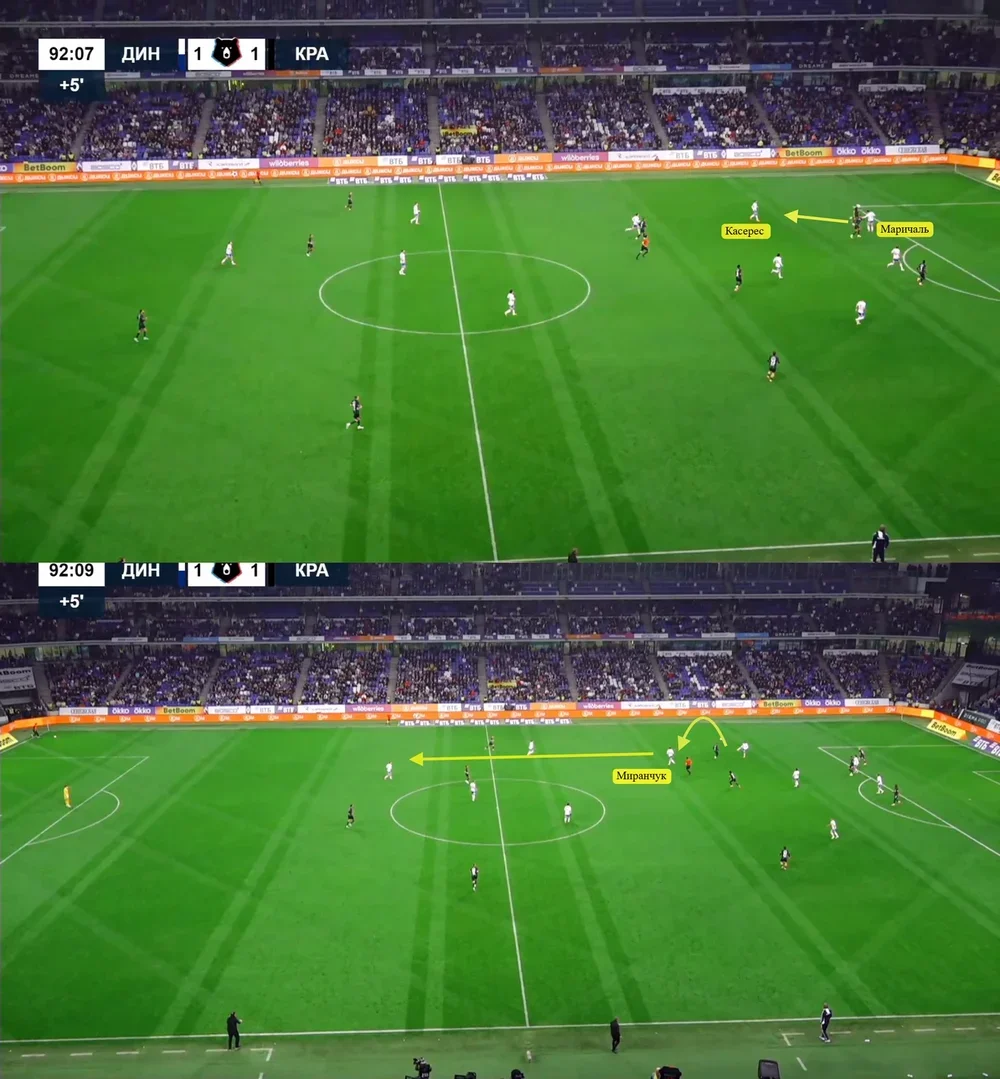
After that, only Luniev shone. And Roland Gusev hurt his team with substitutions, taking off Bitello in the 60th minute and bringing on Miranchuk. As a result, Dynamo’s midfield completely unraveled.
The late chances arose because Krasnodar had to take risks. The same story: Krasnodar cleared the ball to Jubal.