
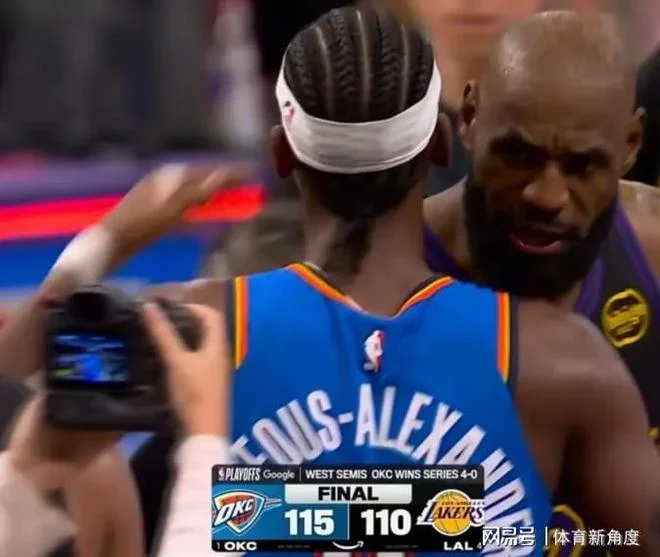
The Los Angeles Lakers entered Game 4 with a glimmer of hope, believing they could force a return trip to Oklahoma City. After all, the Thunder had a sluggish start in the first quarter.
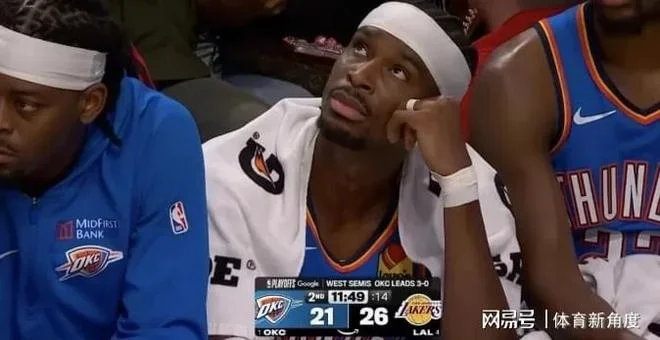
In the previous game, the Lakers held a 2-point lead at halftime for the first time this season against the Thunder. In this contest, they achieved another milestone: their first first-quarter lead over Oklahoma City all season.
Los Angeles led 26-21 after the opening period, marking their largest advantage against the Thunder this year. Remarkably, Oklahoma City failed to earn a single free throw in the first quarter, nor did they record any blocks, steals, or offensive rebounds. Such an unusual performance raised questions about the Lakers’ defensive intensity and offensive flow.
The Lakers held a four-point lead heading into the fourth quarter.
This was also the first time this season—and in the playoffs—that the Thunder entered the final period trailing. The game came down to the wire, a scenario Oklahoma City had not faced in these playoffs. Despite leading in the first quarter, at halftime, and after three quarters, the Lakers could not close out the win. LeBron James missed a critical driving layup in the final moments.
James finished with 24 points, 12 rebounds, and 3 assists on 8-of-18 shooting and 2-of-6 from three-point range. Earlier in the series, analysts suggested the Lakers needed Austin Reaves to score at least 25 points to win, especially when his shooting was off. In this game, Reaves played 43 minutes, hitting 8-of-16 from the field and 3-of-7 from deep, totaling 27 points, 7 rebounds, and 6 assists.
Reaves might wonder why the formula didn’t work. He scored over 25, yet the team was eliminated. He also missed a crucial three-pointer that could have tied the game.
As early as the second quarter, it became apparent the Lakers were in trouble. When the Thunder increased defensive pressure, Los Angeles faltered, committing turnovers that allowed Oklahoma City to build momentum. Similar to Cleveland’s 23-0 run in an earlier game, the Thunder delivered a 17-0 burst in the second quarter.
This playoff pattern seems cruel: give an opponent hope, then crush it with a devastating run.
Before the second quarter even ended, broadcasters began highlighting LeBron James’ career achievements, a signal that might suggest his playing days are winding down.
Defensively, the Lakers gave maximum effort throughout the series. Their strategy was to contain Shai Gilgeous-Alexander, and while they avoided full-court traps this time, their individual defense—particularly from Marcus Smart—was commendable.
Despite their best efforts, Gilgeous-Alexander still scored 35 points on 11-of-22 shooting, along with 8 assists. He went 1-of-4 from three and 12-of-15 from the free-throw line. Without double-teaming him, such production was inevitable.
Overall, the Thunder had an off night. Three of their five starters scored in single digits. Chet Holmgren managed 16 points and 9 rebounds on 9 shots, but his performance lacked aggression aside from a late dunk. Surprisingly, Jaxson Hayes outplayed Holmgren in their matchup. Hayes scored 18 points and grabbed 5 rebounds on 6-of-8 shooting, setting a playoff career high. In the third quarter alone, he scored 8 points on 4-of-4 shooting. Prior to this game, Hayes had totaled just 10 points in the first three games of the series.
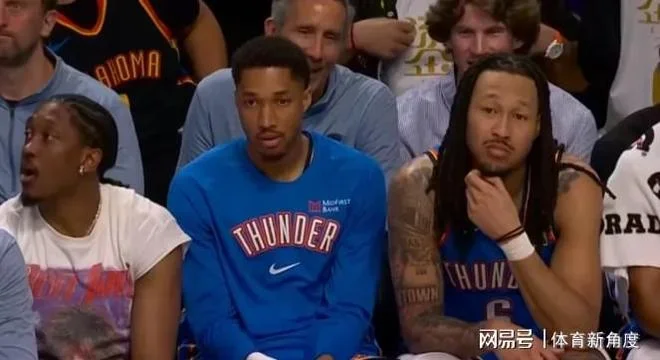
His two-way impact was so impressive that Deandre Ayton could only applaud from the bench.
However, Hayes’ strong two quarters couldn’t match Holmgren’s powerful dunk under pressure.
The Thunder’s role players also stepped up. McCain, despite missing his first six three-point attempts, continued to shoot with confidence when the ball came his way. Teammates trusted him, feeding him the ball even after misses.
Ajay Mitchell was a pleasant surprise, scoring 28 points on 12-of-19 shooting, plus 3 rebounds and 4 assists. His timely three-pointer in the fourth quarter was pivotal.
Alex Caruso contributed 9 points, 4 rebounds, and 1 assist on 3-of-7 shooting, including 3-of-5 from deep. While his stats weren’t flashy, his defensive tenacity and two consecutive three-pointers in the second quarter forced a Lakers timeout, showcasing his impact against his former team.
In summary, this series highlighted the significant gap in system between the Lakers and Thunder. The Lakers gave everything but couldn’t secure a win. Why did the Spurs manage to give the Thunder trouble? Because San Antonio’s defense, led by Victor Wembanyama, is tailored to disrupt Oklahoma City. The Thunder struggle against teams with strong defensive systems. The Lakers, built around three stars, lack that defensive cohesion, especially inside. Their perimeter defenders—Reaves, Luka Dončić, and an aging LeBron—are not elite stoppers. Aside from Smart, the Lakers simply couldn’t match the Thunder’s defensive scheme.
Thus, a busy and challenging offseason awaits the Lakers’ front office as they evaluate and adjust.
*Note: This content represents the personal opinions of the author and is for reference only.*