
Without a World Cup but with Sinner: Tennis Challenges Football’s Reign in Italy
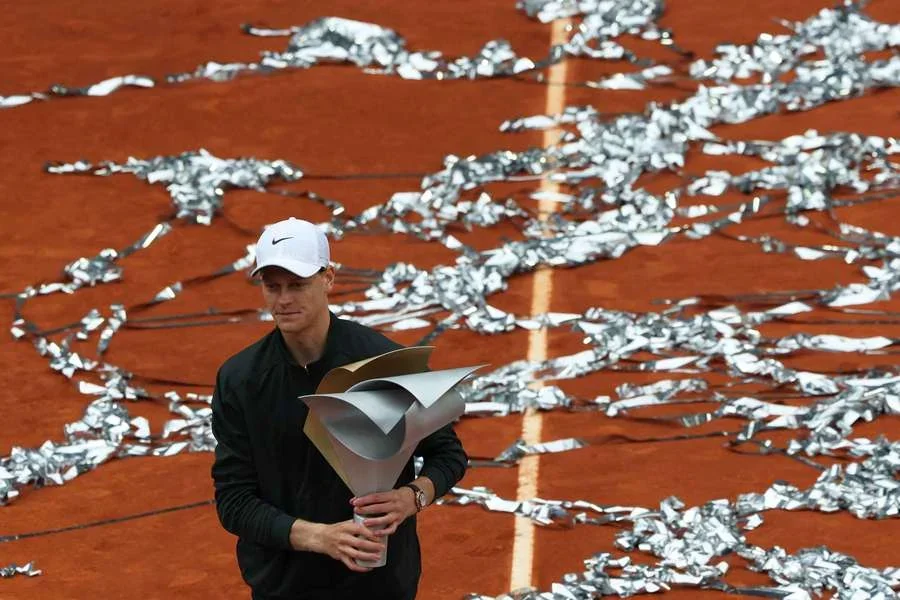
While Jannik Sinner, the overwhelming favorite at the Rome Masters 1000, collects titles at breakneck speed, Italy’s football team will watch its third consecutive World Cup from home. The tennis craze is shaking soccer off its throne as Italy’s undisputed king of sports.
This year, once again, the Rome tournament has gained ground on football—literally. Squeezed into its historic and somewhat outdated home at the Foro Italico, the clay-court event has expanded further into the neighboring Stadio Olimpico, where Roma and Lazio play home games and the national team occasionally hosts opponents.
Organizers expect around 400,000 spectators by May 17 at this venue, a new attendance record (393,000 in 2025). For two years now, the last major stop before Roland Garros has occupied the Stadio dei Marmi, with its 64 colossal white marble statues at the foot of the Olympic Stadium, building a spectacular temporary court with 7,000 seats. And its organizers, who will have a covered and expanded center court (12,500 seats) by 2028, dream of permanently moving into the Olympic Stadium with its 70,000 capacity.
For the president of the Italian Tennis Federation (FITP), Angelo Binaghi, there’s no doubt: “Tennis is surpassing football.”
This is already evident in results. While Italy’s four-time World Cup and two-time European champion football team will miss its third consecutive World Cup this summer, world No. 1 Jannik Sinner has won the last five Masters 1000 events (Paris in 2023, Indian Wells, Miami, Monte Carlo, and Madrid this year). While no Italian club has advanced past the Champions League quarterfinals, Italy has claimed the last three Davis Cup titles (in 2023 without Sinner) and, in the women’s category in 2023, the BJK Cup, driven by World No. 8 Jasmine Paolini, the defending champion in Rome.
This golden age of Italian tennis, amid football’s deep slump, is also reflected in federation license numbers and TV audiences. The FITP, also benefiting from enthusiasm for padel, boasts 1.25 million registered members, 6.2 million practitioners, and 19.1 million “followers,” nipping at football’s heels with its 1.5 million members, 6.5 million practitioners, and 23 million “followers.”
In November, the ATP Finals final in Turin between Jannik Sinner and Carlos Alcaraz, absent from Rome this year due to injury, drew 7 million viewers on Italian television, a 36.6% market share. That same day, the national football team faced Norway in World Cup 2026 qualifying and “only” attracted 7.8 million viewers with a lower market share (33.5%).
“10 Years of Hard Work”
Since the football team’s disaster at the end of March in the European playoff final against Bosnia and Herzegovina (1-1, 4-1 on penalties), there has been talk of using tennis as a model to relaunch football, burdened, according to observers, by obsolete and poor youth development.
“Twenty years ago, we were at the current level of football in terms of results,” emphasizes Michelangelo Dell’Edera, director of the FITP’s Coaching Institute. Although fortunate to have a generational phenomenon like Sinner, tennis carried out its revolution by changing its playing style (“from marathon tennis to speed tennis”), decentralizing its high-performance structures, and expanding its base with 15,000 coaches (compared to 2,500 in 2000). “Football has a lot to learn,” he concludes.